
How Can AI Agents Increase Nonprofit Impact and ROI?
AI Agents for Nonprofits: How to Reduce Administrative Burden, Increase Mission Capacity, and Improve Operational Impact.
AI Agents can increase nonprofit impact when they reduce repetitive administrative work, improve donor, volunteer and participant follow-up, coordinate multi-step workflows, reduce missed handoffs, and help small teams support more people without proportionally increasing administrative workload. The goal is not to replace staff or volunteers. It is to return capacity to the mission. |
Introduction: The Nonprofit Capacity Challenge
Nonprofits are often asked to do more with limited staff, constrained budgets and a strong dependence on volunteers. The work that advances the mission, however, is surrounded by administrative activities: registrations, confirmations, reminders, data entry, donor communications, volunteer coordination, attendance tracking, reporting and follow-up.
When these processes are manual, the organization pays twice: first in staff or volunteer time, and again in the opportunity cost of capacity that could have been directed toward programs, fundraising, community engagement or participant support.
Recent nonprofit technology research shows that AI adoption is still uneven. TechSoup's 2025 benchmark found that 26.2% of surveyed nonprofits were not currently using AI, while 41.7% reported that one or two people were learning how to use it, and 23.7% were making a specific effort to begin using AI. Only 7.4% reported having successfully adopted AI to address operational or mission challenges. These findings suggest that interest and experimentation are ahead of mature, organization-wide implementation.
That creates an opportunity for nonprofit leaders to move beyond experimentation and ask a more useful question: which processes should be improved first, and where can AI create measurable mission value?

What Is an AI Agent for Nonprofits?
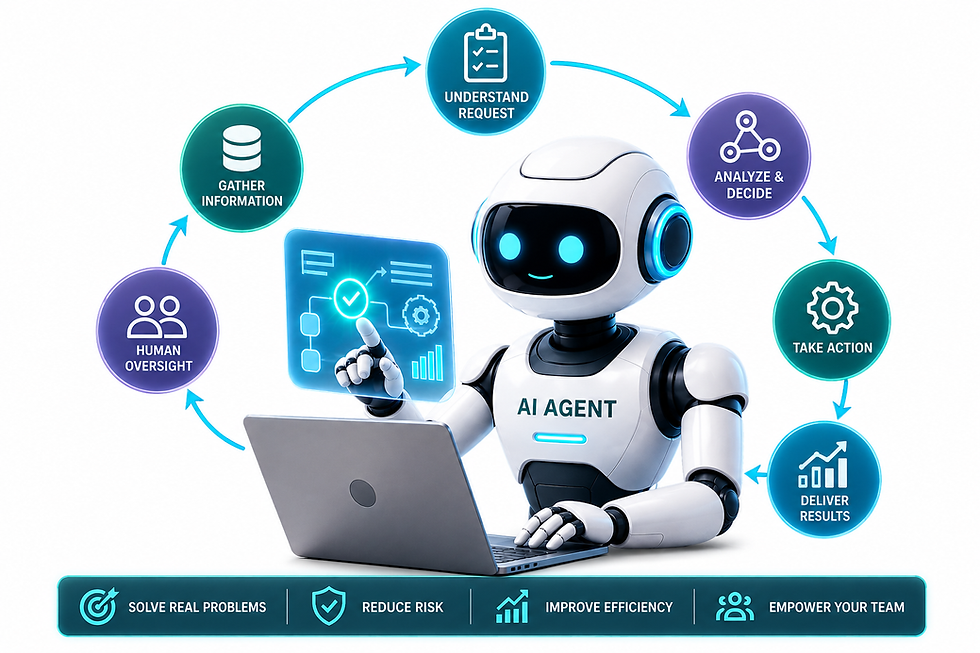
An AI agent is a software system that uses an AI model to interpret context, select among permitted actions and use connected tools or systems to pursue a defined goal with limited autonomy. In a well-designed production environment, the agent operates within explicit permissions, validates outcomes through reliable system feedback and pauses or escalates when risk, uncertainty or exceptions exceed defined thresholds.
For a nonprofit, an agent might receive a participant inquiry, identify the program involved, check whether required information is missing, update an approved system, send a pre-approved response, create a follow-up task and route an exception to a staff member.
The important word is approved. Nonprofits should define what the agent may access, what actions it may perform, what requires approval and when a human must take over.
AI Automation vs. AI Assistant vs. AI Agent
The principle is simple: use the least complex technology that reliably solves the problem.
AI agents can support these outcomes when a process requires understanding information, choosing the appropriate next step or adapting to different situations. Simpler, predictable actions such as sending reminders, updating records, or changing a record status are usually better handled through traditional automation.
Technology | What it is | How it works | Level of autonomy | Best for |
AI Automation | A predefined workflow that uses AI as one or more steps in the process. | Trigger → predefined steps → outcome | 🟢 Low | Repetitive, predictable nonprofit processes |
AI Assistant | An AI tool that helps nonprofit staff or volunteers perform a task by answering questions, generating content, summarizing information, or providing recommendations. | Person asks → AI responds → person decides/acts | 🟡 Medium | Tasks requiring human interaction and judgment |
AI Agent | An AI system that can pursue a defined goal, make decisions within approved boundaries, use connected tools, and execute multiple steps with limited human intervention. | Goal → AI plans → takes actions → evaluates results → adjusts | 🔴 High | Complex, multi-step nonprofit processes requiring interpretation and coordination |
How AI Agents Can Increase Nonprofit Impact and ROI
Nonprofit ROI Is About Mission Value, Not Profit
For nonprofits, the value of an AI or automation investment should be measured by how effectively it helps the organization use its limited resources to advance its mission. Financial savings can be part of the business case, but they are not the only measure of value.
A nonprofit technology investment can create value by:
Increasing operational efficiency — reducing repetitive administrative work and manual coordination.
Expanding staff and volunteer capacity — allowing people to spend more time on programs, relationships, and mission-related activities.
Increasing community reach — enabling the organization to serve more participants, volunteers, or community members without a proportional increase in administrative workload.
Improving service delivery — making communication, registration, follow-up, and program coordination more consistent and responsive.
Reducing unnecessary costs — eliminating avoidable manual work, errors, duplication, or process inefficiencies.
Improving program outcomes — where measurable, demonstrating that the organization is achieving better results for the people and communities it serves.
Nonprofits can evaluate technology investments using a combination of financial, operational, and mission-related measures.
The goal is not simply to save money. It is to make better use of limited resources so the organization can increase its capacity and mission impact.
Nonprofit-Specific AI Agent Use Cases
AI Agents can create value for nonprofits when they help staff and volunteers coordinate multi-step processes, work with incoming information, and take approved actions across systems. The opportunity is not simply to automate tasks, but to reduce administrative effort, increase organizational capacity, improve responsiveness, and enable nonprofits to serve their communities more effectively.
The following business cases illustrate where an AI Agent may add value. In each case, the Agent should operate within clearly defined rules, permissions, and escalation points, with people retaining responsibility for ambiguous or sensitive decisions.
Business Case | How an AI Agent Can Help | Potential Value to the Nonprofit | Human Oversight |
Inquiry Intake | Interpret incoming requests, capture relevant information, and route them to the appropriate program or team. | Faster responses, less manual triage, and better use of staff capacity. | Review requests that are ambiguous, sensitive, or cannot be confidently routed. |
Participant Registration | Identify missing information, update approved records, and trigger onboarding communications. | Reduces administrative work and helps participants move through registration more efficiently. | Staff review exceptions and determine how incomplete or unusual registrations should be handled. |
Volunteer Coordination | Trigger reminders, training steps, confirmations, and task assignments based on approved workflows. | Reduces coordination effort and helps volunteers complete required steps on time. | Staff or volunteer coordinators manage exceptions and changes to volunteer assignments. |
Donor Follow-Up | Identify approved follow-up actions, prepare messages, and update CRM activity. | Reduces manual CRM administration and helps maintain consistent donor communications. | Staff approve messages or actions that require judgment, personalization, or sensitive donor handling. |
Program Attendance | Consolidate approved attendance data and flag exceptions for review. | Reduces manual data consolidation and makes attendance information easier to monitor. | Program staff review discrepancies and determine how exceptions should be resolved. |
Grant Reporting Support | Organize source information and prepare draft summaries for staff review. | Reduces time spent gathering information and preparing recurring reporting materials. | Staff validate the information, interpret results, and approve the final report. |
CRM Administration | Perform approved record updates, maintain workflow information, and escalate ambiguous cases. | Reduces repetitive CRM maintenance and improves data consistency. | Ambiguous records, conflicting information, or changes requiring judgment are escalated to staff. |
Operational Reporting | Prepare draft operational summaries and dashboards using approved data. | Gives staff faster access to information needed to monitor programs and operations. | Staff validate the data and interpret findings before using them for decisions. |
Which Tasks Actually Need an AI Agent?
The fact that a workflow contains several steps or systems does not make it agentic. Use an agent when the appropriate path cannot be fully predefined and the system must interpret context, select among approved tools or adapt its next step. Keep predictable actions like record creation, notifications, certificate generation and fixed approvals, inside deterministic automation.
Capability | Rules-Based Automation | AI Assistant | AI Agent |
Primary role | Execute predefined steps | Answer, summarize or create information | Coordinate multiple approved steps toward a goal |
Decision logic | Fixed rules | User/context dependent | Interprets context within guardrails |
Typical input | Structured data | Questions/prompts | Messages, documents and system data |
Best nonprofit use | Reminders, record updates, notifications | Drafting, FAQs, summaries | Intake, routing, follow-up and coordination |
Human oversight | Exceptions | Review outputs | Approvals, escalation and monitoring |
Complexity | Low | Moderate | Higher |
Risk | Usually lower | Depends on data/access | Increases with autonomy |
1TC Perspective Don't start with the Agent. Start with the process. |
When Traditional Automation Is Better
Traditional automation is often better when the process is predictable, inputs are structured, rules are clear, the same trigger produces the same action, and exceptions are limited.
For example: when a participant completes an approved registration form, create the record, assign the onboarding checklist and send a confirmation email. That may be a straightforward workflow automation problem.
An AI Agent becomes more attractive when information is unstructured, interpretation is required, the next action depends on context, several systems must be coordinated, or the workflow contains manageable variations that can be safely handled within defined guardrails.
Nonprofit Workflow Examples
Workflow | AI Agent Role | Human Role | Impact Opportunity |
Program intake | Interpret inquiry, capture approved information and route | Review exceptions and eligibility | Faster response and less manual intake |
Volunteer coordination | Trigger reminders, onboarding and task routing | Manage relationship and exceptions | Lower admin effort and higher participation |
Donor follow-up | Identify approved follow-up actions and update CRM | Manage donor relationship and asks | More consistent engagement |
Registration | Check completeness and initiate onboarding | Handle unusual cases | Fewer incomplete records |
Reporting | Organize information and draft summaries | Validate facts and submit | Less reporting preparation time |
Certification | Trigger approved certificate workflow | Verify completion criteria | Faster, more consistent delivery |
CRM administration | Create/update records and tasks | Review exceptions | Less duplicate data entry |
How to Measure Nonprofit ROI
Before implementing an AI Agent, establish a baseline. Measure the current process rather than starting with the software cost.
Useful metrics may include: administrative hours per month; volunteer hours spent on administration; response time; registration completion; donor follow-up completion; volunteer participation; program completion; reporting preparation time; duplicate or incomplete records; missed follow-ups; cost per transaction; number of participants served; and funding or revenue opportunities affected.
A practical formula is: ROI = (Annual Benefit − Annual AI Agent Cost) ÷ Annual AI Agent Cost × 100
Annual benefit can include direct cash savings, avoided costs, incremental or protected revenue/funding, capacity-generated value and quantifiable program value. The organization should avoid double counting when the same released capacity generates the revenue or program benefit being measured.
How to Classify Nonprofit Benefits
Benefit Type | What It Means | Example | Financial Treatment |
Capacity released | Staff or volunteer time is freed for higher-value work | 6 hours/week no longer spent on administrative coordination | Business/mission value; not automatically cash savings |
Direct cash savings | Actual expense decreases | Less overtime or outsourced administrative work | Direct cost reduction |
Avoided future cost | A planned expense is no longer necessary | Supporting another cohort without a planned admin hire | Count only when the cost would otherwise occur |
Incremental/protected funding | Additional or protected fundraising or program revenue | Consistent donor follow-up recovers opportunities | Financial benefit; avoid double counting capacity |
Program value | More people served or better program delivery | More participants supported with the same team | Mission outcome; quantify where practical |
An Illustrative Nonprofit AI Agent ROI Example
Consider a hypothetical nonprofit that manages 500 participant/member interactions per month. Each interaction requires an average of 12 minutes of administrative work.
If an AI-enabled workflow reduces administrative effort by 6 hours per week, the organization can redirect that time to participant support, volunteer coordination, program delivery, or other mission-related activities.
The example below shows how the organization could quantify the potential value.
Measure | Example |
Administrative time saved | 6 hours/week |
Approximate annual capacity recovered | 312 hours/year |
Illustrative fully loaded staff/contractor rate | $30/hour |
Illustrative annual capacity value | $9,360 |
Estimated reduction in rework/avoidable costs | $2,000/year |
Illustrative measurable financial value | $11,360/year |
AI Agent technology, implementation, integration, training & support | $6,000/year |
Illustrative net measurable value | $5,360/year |
How the calculation works:
6 hours saved per week × 52 weeks = 312 hours of capacity recovered
312 hours × $30/hour = $9,360 in capacity value
$9,360 + $2,000 avoided/reduced costs = $11,360 measurable value
$11,360 − $6,000 technology and implementation cost = $5,360 net measurable value
What this example does, and does not, measure:
This is an illustrative example, not a prediction of results. The nonprofit should replace these assumptions with its own baseline data and measured results.
Importantly, the $9,360 should not automatically be treated as cash savings. It represents the estimated value of staff or volunteers’ capacity that has been recovered. The real nonprofit benefit may be the ability to:
serve more participants;
support more volunteers;
respond faster to community needs;
deliver more program activities; or
redirect staff time from administration to mission-related work.
This is why, for nonprofits, AI Agent value should be evaluated using both financial measures and operational or mission-related outcomes.
Important Note: This is an illustrative business case, not a guaranteed nonprofit result. Replace assumptions with the organization's measured baseline. |
Capacity Released vs. Cash Savings
This distinction is essential for nonprofit ROI.
If a staff member continues to work the same paid hours, the organization has not necessarily reduced payroll. It has released capacity. That capacity may support more participants, more donor outreach, more grant activity, better reporting or additional programs.
Capacity becomes a direct cash saving only when it results in an actual expense reduction, such as eliminating paid overtime or outsourced administrative work.
Do not automatically convert hours saved × hourly wage into cash savings.
What an AI Agent Should Not Decide Without Human Approval Nonprofits should establish stronger human controls for beneficiary eligibility, sensitive personal information, financial approvals, grant compliance certifications, donor disputes, employment decisions, legal matters, safety, crisis situations and high-impact program decisions.
Recommended controls include least-privilege access, approval thresholds, escalation rules, audit logs, data-access restrictions, monitoring, clear ownership and human review. The more authority an agent receives, the stronger the governance needs to be.
Nonprofit AI Readiness Checklist
Use the checklist below to assess your AI Readiness.
# | Readiness Question | What to Confirm | Flag |
1 | Is the process clearly documented? | Current workflow, steps, roles, and exceptions are understood. | ☐ |
2 | Do we know the current time, cost, and volume? | Establish the baseline for frequency, time, and resource requirements. | ☐ |
3 | Is the problem important enough to justify change? | Confirm meaningful impact on capacity, service delivery, cost, or community reach. | ☐ |
4 | Can success and failure be tested objectively? | Define measurable conditions for determining whether the process works as expected. | ☐ |
5 | Could traditional automation solve it more simply? | Determine whether rules-based automation can achieve the desired outcome. | ☐ |
6 | What systems contain the required data? | Identify the CRM, LMS, forms, spreadsheets, communication platforms, or other systems involved. | ☐ |
7 | What personal or sensitive data is involved? | Identify participant, donor, volunteer, employee, financial, or other sensitive information. | ☐ |
8 | What actions may the Agent perform? | Define the specific actions and boundaries authorized for the Agent. | ☐ |
9 | Which actions require human approval? | Identify decisions or actions that require staff review before execution. | ☐ |
10 | How will success be measured? | Define KPIs for efficiency, capacity, service delivery, cost, or mission-related outcomes. | ☐ |
11 | Who owns the workflow after implementation? | Identify the person or team responsible for monitoring and maintaining the workflow. | ☐ |
30-60-90 Day Implementation Roadmap
Days 0–30 — Discover: map processes, identify pain points, establish baseline metrics, assess data and define risk boundaries.
Days 31–60 — Simplify and Pilot: remove unnecessary steps, automate deterministic work, configure a focused AI use case, train users and test exceptions.
Days 61–90 — Measure and Scale: compare results to baseline, refine prompts and workflows, strengthen governance, document lessons learned and decide whether to expand.
A Practical Example: Improving Nonprofit Learning Program Process
A nonprofit organization supports women entrepreneurs through education, mentoring and business development. As participation exceeded 1,200 students per cohort, manual processes became a barrier to scale.
Documented challenges included manual attendance validation, duplicate data entry, manual certificate generation, limited visibility into participant progress and high volunteer effort. 1mpact Technology Consulting worked 100% pro bono to assess the environment, document current processes, evaluate LMS platforms and design a future-state operating model focused on automation, scalability and nonprofit sustainability.
The recommended architecture used LearnWorlds as the Learning Management System and monday.com as the Student System of Record with workflow automation. Expected outcomes included streamlined registration, attendance, communications and certification; improved volunteer coordination; dashboards and reporting; reduced administrative effort; and greater ability to support additional cohorts. AI automation and AI Agent capabilities were incorporated into the end-to-end solution to make the overall process easier for volunteers and program coordinators to manage.
The lesson is directly relevant to AI Agents: do not start by asking where to deploy an agent. Start by understanding the process, simplifying it, connecting the systems and measuring the outcome. Add AI autonomy only where it creates incremental value.
The 1mpact Technology Consulting Approach
1mpact Technology Consulting approaches nonprofit technology from a process-first perspective:
Discover → Simplify → Automate → Add AI Where It Creates Value → Control → Measure → Scale
The goal is not to deploy more AI. The goal is to help a nonprofit use the right level of technology to increase mission capacity, improve sustainability and deliver measurable value without creating unnecessary complexity.
Frequently Asked Questions
1. What is an AI Agent for nonprofits?
An AI Agent is software that can interpret information, determine the next approved step, use connected systems to execute multiple actions, check results and escalate exceptions to people. For nonprofits, this can support program operations, volunteer coordination, donor follow-up, registration, communications and reporting. The agent should operate within defined permissions and governance rules rather than making unrestricted decisions.
2. What nonprofit tasks can AI Agents automate?
AI agents are best suited for tasks that require understanding information, choosing the appropriate next step, or adapting to different situations. For example, classifying complex inquiries, reviewing incomplete applications, or recommending follow-up actions are use cases nonprofits can benefit by using an AI Agent. Predictable tasks, such as sending reminders or updating records, are usually better handled through traditional automation.
3. Can AI Agents help nonprofits improve fundraising?
They can support fundraising operations by identifying approved follow-up actions, preparing personalized drafts, updating CRM records, segmenting information and reminding development staff about opportunities. Human staff should remain responsible for donor relationships, sensitive communications, financial decisions and strategy.
4. Can AI Agents help manage volunteers?
Yes. An agent can help coordinate onboarding, reminders, training steps, confirmations, schedules and task routing. This can reduce administrative effort and improve consistency while preserving the human relationship that is central to volunteer engagement.
5. Should a nonprofit use an AI Agent or traditional automation?
Use traditional automation when rules are predictable and the same trigger reliably produces the same action. Consider an AI Agent when the workflow requires interpretation, classification, contextual routing. The least complex reliable solution is usually the best starting point.
6. How can nonprofits reduce AI-agent risk?
They can be used responsibly when access, permissions, data handling, approvals and monitoring are controlled. Nonprofits should be especially careful with personally identifiable information, beneficiary data, donor information, financial records and other sensitive information. High-impact decisions should remain under appropriate human oversight.
7. Does a nonprofit need an IT team to implement an AI Agent?
Not necessarily. It does need clear ownership, process knowledge, appropriate data and system access, governance and ongoing measurement. A technology advisor can help a nonprofit assess readiness, prioritize use cases, design workflows, implement integrations and establish controls when internal technical resources are limited.
Explore Your Nonprofit Opportunities!
Is your nonprofit team spending too much time coordinating repetitive work? 1mpact Technology Consulting can help you identify the highest-value automation opportunities, evaluate where AI Agents make sense, and build a practical roadmap based on measurable business outcomes. Schedule a Free Nonprofit Technology Consultation! Click here. |
Author & Expertise
Written by Rose Fasanelli, Partner & Business Development Director.
Rose Fasanelli brings more than 35 years of global technology leadership experience across digital transformation, business growth, customer experience, AI, automation and technology-enabled innovation. She has been recognized as a HITEC 100 honoree and brings enterprise-level technology experience to the SMB market. Connect via LinkedIn
Reviewed by Vanessa Ballarte, Partner & AI Solutions Director.
Vanessa is a business and technology executive with more than 25 years of experience across corporate strategy, P&L management, operations, AI & digital transformation. A former Managing Director and Board Member of OMRON Healthcare, Vanessa now serves as Director of AI Solutions at 1TC, where she helps organizations turn strategic priorities and emerging technologies into practical solutions that deliver measurable business impact. Connect via LinkedIn
References
Source | Relevant Links |
TechSoup / Tapp Network — The State of AI in Nonprofits 2025 | |
TechSoup — State of AI in Nonprofits 2025 Benchmark Report PDF | |
NTEN — Technology adoption in nonprofits: An analysis of Tech Accelerate data | |
NTEN — Before your nonprofit automates: Four questions to keep people at the center | |
Salesforce — Nonprofit Trends Report, 7th Edition | |
NIST — AI Risk Management Framework | |
1mpact Technology Consulting Website | |
1mpact Technology Consulting - Blog - AI Agents for Small Business |


Comments