
AI Agent for Small Business: When Do They Make Sense?
Updated: Aug 26
A direct answer to this question AI Agents make sense for small businesses when a workflow requires more than predictable, rules-based automation. They are most useful when the work involves interpreting unstructured information, handling variations or exceptions, making context-based decisions, and coordinating actions across multiple steps or systems. If the process is predictable and the next step can be defined by clear rules, traditional automation is usually simpler, safer, and easier to manage. The right approach depends on the process, data, level of risk, and measurable business value. |
An AI Agent can do more than answer a question or generate content: it can interpret information, determine what to do next, use approved tools, and complete a sequence of tasks towards a specific business goal. For an SMB, that can reduce administrative friction, but only when the process is ready, the risk is understood, and the agent has a clear job.
For SMBs the opportunity is practical: it can reduce repetitive administrative work that consumes employee time and slows down operations. AI and automation can support activities such as scheduling, lead follow-up, customer communications, document processing, data entry, and reporting. This frees employees to focus on customer and revenue generating activities that require human judgement.
Executive Summary
AI Agents can expand labor capacity by handling coordinated administrative work such as intake, follow-up, document processing, and routing. But autonomy adds risk. This article explains where agents fit, where they do not, how to assess readiness, and how 1TC moves businesses from rules-based automation to AI-assisted and agentic workflows.
What Is an AI Agents for SMBs?
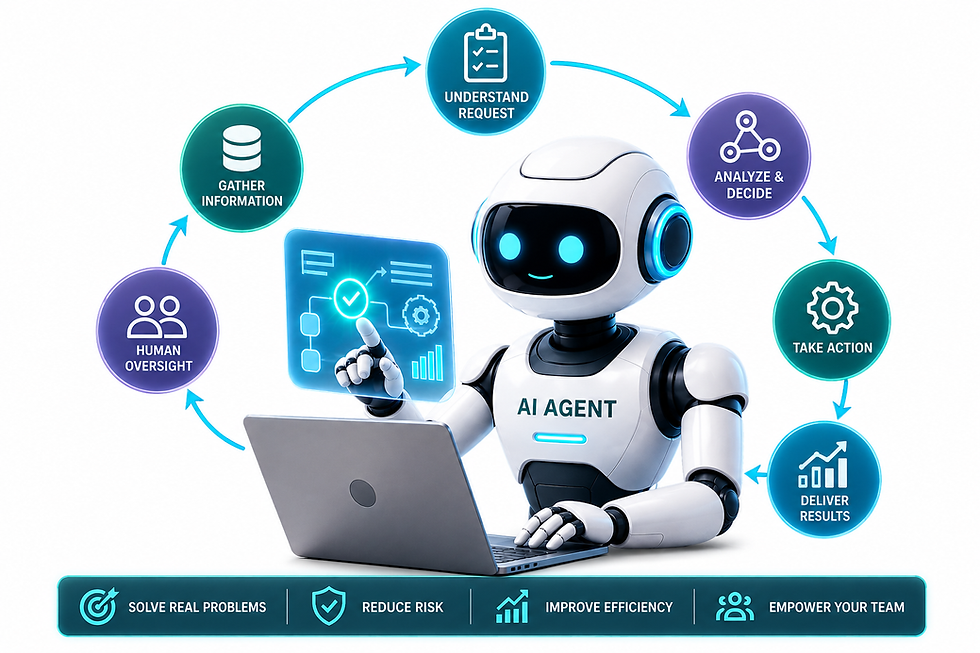
An AI Agent is software designed to pursue a defined goal by interpreting information, determining the next appropriate action, and using approved tools or systems to complete part of a workflow. Unlike a basic chatbot, an agent is typically designed to carry work across multiple steps and systems.
Artificial intelligence agents are not a replacement for business ownership or accountability. They are technology tools that operate within permissions, rules, data boundaries, and escalation paths defined by the business.
AI Agent vs. chatbot vs. automation
Capability | Rules-based automation | AI assistant / chatbot | AI Agent |
Primary role | Execute predictable steps | Generate or explain information | Coordinate and execute a multi-step goal |
Decision logic | Fixed rules and triggers | AI-generated response | AI interprets context and selects next steps |
System access | Usually predefined integrations | Often limited or read-only | Can use approved tools and systems |
Best fit | Reminders, assignments, notifications | Questions, drafting, summaries | Multi-step intake, routing, follow-up and coordination |
Risk level | Typically lower | Varies by data and permissions | Higher as autonomy and permissions increase |
Human oversight | Exceptions and approvals | Review outputs | Defined approvals, guardrails and monitoring |
Should Your Small Business Use an AI Agent?
Not automatically. Use an AI Agent when it solves a meaningful operational problem better than a simpler, more predictable solution. AI workflow automation for SMBs does not always require an AI Agent - it can rely on rules-based automation for repetitive, predictable workflows and introduce AI only where interpretation or adaptive decision-making adds value.
1TC Perspective Start with the least complex technology that can reliably solve the business problem. Increase autonomy only when the business benefit justifies the additional complexity and risk. |
For many SMBs, the first win is still rules-based automation. If the process says, 'When a form is submitted, create a CRM record, assign it, send a confirmation, and create a task,' there may be no reason to add an agent.
An AI Agent becomes more useful when the work requires interpretation. For example, a property manager may receive a free-form tenant message that contains a property address, a maintenance issue, urgency cues, and missing information. An agent could interpret the message, extract the details, check the record, request missing information, route the issue, and prepare the next task, subject to defined controls.
The right starting point is not ‘Where can we use an AI Agent?’ It is ‘Where is our team losing time, capacity, or consistency? That process-first approach is the foundation of business process automation: simplify the workflow, automate predictable steps, and introduce AI only where it adds measurable value.
Why AI Agents Matter to the SMB Owner
SMBs often have limited administrative capacity. Owners and managers can spend hours each week moving information between email, CRM, scheduling, accounting, project-management, and document systems.
The goal is not simply to eliminate jobs. The bigger opportunity is to expand the capacity of the people already running the business. 1TC describes this as automating the work around the work—reducing administrative friction so employees can spend more time on customers, revenue-producing activities, project execution, and decisions that require human expertise.
The U.S. Census Bureau reported that overall business AI use stayed around 17%–20% from December 2025 through early May 2026, while less than 20% of firms with four or fewer employees reported using AI. That gap matters: SMB adoption is real, but it is not universal, and smaller companies should focus on practical use cases rather than technology for its own sake. (Source: U.S. Census Bureau, Business Trends and Outlook Survey analysis, May 2026.)
NFIB's 2025 Small Business and Technology Survey found that 24% of small employers were using AI, while 30% of AI users reported increased productivity. The survey also found that 98% of AI-using small employers reported no change in employee count. These findings do not suggest that AI adoption automatically translates into workforce reductions. For SMB leaders, this reinforces the value of evaluating AI as a capacity and productivity tool rather than assuming its primary purpose is headcount reduction. (Source: NFIB, 2025 Small Business and Technology Survey.)
Where AI Agents Can Help Small Business
The strongest candidates for an AI Agent are often administrative workflows that are frequent, measurable, multi-step, and difficult to handle with fixed rules alone.
Business type | Potential agent workflow | Human boundary |
General contractors & home services | Lead intake → classify request → create CRM record → request missing details → schedule follow-up → escalate | Estimating, pricing, technical judgment and customer commitments |
Realtors | Lead intake → identify intent → update CRM → coordinate appointment → prepare follow-up | Negotiation, advice, relationship decisions |
Property managers & HOAs | Maintenance request → extract property/problem → check context → route vendor → send status updates → escalate | Urgent, sensitive, legal, financial or unusual decisions |
Nonprofits | Participant intake → check completeness → request missing information → create tasks → prepare communications | Mission-critical, sensitive and eligibility decisions |
Wellness & spas | Inquiry → classify service → schedule → reminders → follow-up → review request | Sensitive customer issues and exceptions |
AI Agents for South Florida Small Businesses: Where They Can Make the Biggest Difference
For South Florida small and mid-sized businesses, the value of an AI Agent is often found in the everyday work that keeps the business moving - responding to inquiries, coordinating appointments, following up with customers, routing requests, managing documents, and keeping teams on track. These businesses often operate with lean teams, making it especially important to reduce repetitive administrative work without losing the human interaction customers expect. The right opportunity depends on the business process, not simply the industry or the availability of an AI tool.
South Florida SMB Segment | Where an AI Agent Can Help | Potential Business Impact | Human Role |
Home Services | Lead intake, qualification, estimate follow-up, appointment coordination, service-request routing | Faster lead response, fewer missed opportunities, better follow-up, more capacity for field and sales teams | Pricing, estimates, customer issues, complex service decisions |
Property Management & HOAs | Maintenance-request intake, request classification, vendor routing, resident communications, status updates | Faster response, clearer ownership, less administrative coordination, better visibility | Vendor decisions, escalations, legal matters, emergencies |
Real Estate / Realtors | Lead qualification, inquiry response, appointment scheduling, follow-up, CRM updates | Faster response, more consistent follow-up, improved lead management and salesperson capacity | Property recommendations, negotiations, contracts, client relationships |
Wellness & Spas | Customer inquiries, appointment scheduling, reminders, intake information, post-appointment follow-up | Fewer administrative tasks and no-shows, faster responses, improved customer experience | Client care, sensitive situations, service recommendations |
Nonprofits | Participant/volunteer intake, information routing, communications, recurring reports, administrative coordination | Reduced manual work, faster responses, better volunteer capacity and program administration | Eligibility, sensitive decisions, program management, mission-critical decisions |
Start With the Process, Not the Industry
The fact that a business belongs to one of these segments does not automatically mean it needs an AI Agent. The strongest candidates are usually frequent, repeatable, measurable workflows that involve multiple steps and require some level of interpretation or coordination.
For example, a property management company may benefit from an AI Agent that classifies maintenance requests and routes them to the appropriate person or vendor. A home-services company may benefit more from automated lead follow-up. A spa may need appointment automation rather than an AI Agent. In each case, the technology should match the process.
For South Florida SMBs, the objective is not to replace the personal service that differentiates their businesses. It is to reduce the repetitive work behind that service so owners and employees can spend more time on customers, revenue, and decisions that require human judgment.
You can benefit of the AI Readiness Assessment provided by 1TC.
When Traditional Automation Is Better Than an AI Agent
Do not use an AI Agent just because it is newer. Traditional workflow automation remains the better choice when the process is predictable, rules are clear, inputs are structured, and the consequences of a mistake are meaningful. If a workflow can be expressed reliably as “when X happens, do Y,” an AI Agent may add complexity without adding meaningful value.
1TC Perspective Do not use an AI Agent just because it is the newest technology. Use it only when it solves a business problem better than a simpler approach. |
Use rules-based automation when… | Consider an AI Agent when… |
The same trigger produces the same next step | The next step depends on context |
Inputs are structured fields | Inputs arrive as emails, documents or free-form messages |
Rules can be written clearly | The process requires interpretation or classification |
The workflow has few exceptions | The workflow has manageable variations |
A deterministic integration can solve it | Multiple systems and steps must be coordinated |
A wrong action would be costly | The agent can safely escalate before consequential action |
AI Agent Readiness: The Five Questions to Ask First
A promising AI Agent use case does not automatically mean the business is ready to deploy one. Evaluate opportunity and readiness separately.
1. Is the process stable enough to automate?
If employees are still changing the process every week, automate the process design first. An agent cannot compensate for unclear ownership, conflicting rules, or inconsistent approvals.
2. Is the data reliable?
Agents depend on the information they can access. McKinsey's April 2026 research on scaling agentic AI reported that nearly two-thirds of enterprises had experimented with agents, but fewer than 10% had scaled them to tangible value; eight in ten cited data limitations as a roadblock. Although this research focuses on larger enterprises, the underlying lesson is highly relevant to SMBs: reliable data and system foundations often matter more than adding another layer of AI.
3. What is the cost of a wrong action?
An agent that drafts a follow-up email is not the same risk as an agent that changes a financial record, approves a vendor, sends a contractual commitment, or makes a customer-impacting decision. Define the consequence before granting autonomy.
4. Can a human intervene meaningfully?
Human-in-the-loop should not mean clicking 'approve' without understanding what the agent did. Approval should be tied to a clear decision threshold, visible context, and an audit trail.
5. Can you measure the business outcome?
Baseline the process before deployment. Track transaction volume, human minutes per transaction, response time, errors, rework, backlog, and downstream business outcomes.
More Autonomy Requires More Control
An AI Agent that only reads or summarizes information carries a different level of risk from one that can change records, send communications, approve transactions, or trigger actions in another system. As an agent receives more access and autonomy, the controls around it should increase as well. Businesses should limit access to only what the agent needs, define approval and escalation rules, maintain activity logs, and have a practical way to stop or reverse automated actions when necessary. Information coming from emails, documents, websites, or other external sources should also be treated carefully so it cannot improperly influence what the agent is allowed to do.
You may benefit of the Fractional CAIO Service to ensure your AI agent will not risk your business without the right controls that are needed.
A Practical AI Agent Readiness Checklist
Use this checklist before buying or building an AI Agent. A 'no' answer is not a failure; it tells you what foundation to improve first.
· Identify one repetitive process with a clear business owner.
· Document the current workflow, including systems, handoffs, approvals and exceptions.
· Measure current time, volume, response time, errors and rework.
· Confirm which system is the source of truth for customer, financial, project or property data.
· Decide whether rules-based automation can solve the process before adding AI.
· Identify the exact tasks an AI Agent may perform and the tasks it must never perform.
· Define permissions, approval thresholds, escalation rules and audit logging.
· Pilot in a low-risk workflow before expanding autonomy.
· Train employees on what the agent does, what it does not do, and when to intervene.
· Review results against the baseline and calculate business value before scaling.
Before buying or building an AI Agent, consider completing an AI readiness assessment to evaluate your workflow, data, ownership, security and measurement foundation.
How to Measure the ROI of an AI Agent
An AI Agent should be measured by the business value it creates, not by how advanced the technology is. Before implementation, establish a baseline for the current process—such as time spent, labor involved, response time, errors, missed opportunities, and volume handled. Then define the outcomes the AI Agent is expected to improve, such as reducing administrative hours, speeding up customer response, increasing lead conversion, reducing errors, or allowing the team to handle more work without adding equivalent staff.
A practical business case can consider labor capacity released, revenue impact, error or rework savings, and avoided costs. The following variables can be used to build a simple ROI calculation:
ROI Variable | What to Measure | Example |
Hours saved | Employee hours reduced by automation | 7 hrs/week |
Labor cost per hour | Fully loaded hourly cost of the employee(s) involved | $30/hour |
Annual labor capacity released | Hours saved × 52 weeks × labor cost | $10,920 |
Additional revenue | Revenue generated or protected through faster response, better follow-up, or increased capacity | $8,000/year |
Error/rework savings | Costs avoided through fewer errors, corrections, duplicate work, or missed requests | $2,000/year |
Avoided costs | Other recurring costs reduced or eliminated | $1,000/year |
Annual business benefit | Labor capacity + revenue impact + error savings + avoided costs | $21,920 |
AI Agent cost | Software + implementation + integration + training + support | $7,000/year |
Net annual benefit | Annual business benefit − AI Agent cost | $14,920 |
ROI | (Annual Business Benefit − AI Agent Cost) ÷ AI Agent Cost × 100 | 213% |
Payback period | Initial investment ÷ monthly business benefit | ~4 months |
Simple ROI Formula
ROI = (Annual Business Benefit − AI Agent Cost) ÷ AI Agent Cost × 100
For example, if an AI Agent creates an estimated $21,920 in annual business value and costs $7,000 per year, the potential ROI would be approximately 213%. This is an illustrative example; actual results depend on the process, implementation cost, adoption, performance, and business conditions.
The most important step is to compare results before and after implementation. Track KPIs such as response time, hours saved, follow-up completion, conversion rate, errors, customer experience, and volume handled. After the first 30–90 days, determine whether the AI Agent is delivering measurable value. If it is reliable, adopted by the team, and producing a positive business case, consider expanding it. If the results are limited, simplify or adjust the workflow, or determine whether traditional automation could achieve the same outcome with less complexity.
1TC Perspective The goal is not to deploy more AI. The goal is to create measurable business value with the right level of automation, cost, risk, and human oversight. |
1TC's Practical AI Adoption Framework:
Rules-Based → AI-Assisted → Agentic
1mpact Technology Consulting (1TC) does not start with an AI Agent. It starts with the business process. The goal is to choose the simplest technology that reliably solves the problem and then increase sophistication only when the business case supports it. This is 1TC's practical adoption framework, not a requirement that every business progress to agentic AI.
Stage | What it means | Typical SMB use |
Rules-Based | Triggers, rules, integrations and scheduled actions execute predictable work | Reminders, lead routing, CRM updates, scheduling, recurring reports |
AI-Assisted | AI interprets, extracts, classifies, summarizes or drafts while people remain in control | Document intake, inquiry classification, summaries, personalized follow-up |
Agentic | An AI Agent coordinates several steps and uses approved tools to pursue a defined workflow goal | Multi-step onboarding, request triage, cross-system coordination |
This progression reduces unnecessary complexity. It also makes adoption easier because the business can prove value at each stage instead of attempting an enterprise-style AI transformation all at once.
1TC helps SMBs evaluate the process first, determine the appropriate level of automation, implement the technology, establish practical controls, and measure the outcome. When ongoing technology leadership is needed, 1TC can also provide Fractional CTO or Fractional CAIO support.
1TC Perspective: Don't start with the Agent The right starting point is not “Where can we use an AI Agent?” It is “Where is our team losing time, capacity, or consistency?” First simplify the process. Then automate predictable work. Add AI where interpretation is required. Introduce agentic behavior only when the workflow, data, controls, and business case justify it. |
Top Frequently Asked Questions
1. What is an AI Agent for a small business?
An AI Agent is software that can interpret business information, decide the next step within defined rules, permissions and guardrails while using approved tools to complete a multi-step workflow with limited human intervention.
2. How is an AI Agent different from a chatbot?
An AI Agent interprets context, determines the appropriate next steps, and uses connected tools or systems to carry out actions within predefined goals, permissions, and guardrails, while a chatbot primarily interacts with users by answering questions, retrieving information, or generating responses.
3. Should a small business use an AI Agent or traditional automation?
A small business should use traditional automation for predictable rules and consider an AI Agent when the workflow requires interpretation, coordination, contextual decisions, or multiple connected steps.
4. What business processes are best for AI Agents?
The best candidates are frequent, measurable, multi-step administrative workflows such as intake, routing, document processing, follow-up, onboarding, service coordination, and cross-system information movement.
5. Are AI Agents safe for financial or customer data?
Whether an AI Agent should handle sensitive customer or financial data depends on the platform, data sensitivity, access permissions, security controls, retention policies, auditability, data-minimization practices and applicable regulatory requirements.
6. Do AI Agents require an internal IT team?
Not necessarily, but someone must own the process, integrations, permissions, controls and ongoing monitoring. That responsibility can sit with an internal employee, IT provider or external technology advisor. An SMB can use an external technology advisor to assess readiness, design workflows, implement integrations, establish controls, train users, and provide ongoing technology leadership without hiring a full-time IT executive.
7. How do I know if my business is ready for an AI Agent?
Your business is more ready when the process is stable, data is reliable, ownership is clear, outcomes are measurable, permissions are defined, and the consequences of errors are understood before autonomy is introduced.
8. What should I automate before using an AI Agent?
Start with predictable steps such as data entry, routing, reminders, approvals, and system updates, then add AI only where interpretation, classification, extraction, or contextual work creates measurable business value.
Authors & Expertise
Written by Rose Fasanelli, Partner & Business Development Director
Rose is a technology executive and entrepreneur with 30+ years of global leadership experience across digital transformation, business growth, customer experience, AI, automation and technology-enabled innovation. A 2025 HITEC 100 honoree, HITEC Fellow and Mentor, she brings enterprise-level experience to the SMB market.
Reviewed by Vanessa Ballarte, Partner & AI Solutions Director.
Vanessa brings 20+ years of experience in strategy, operations, digital transformation, and AI/ML, helping organizations turn technology and data into measurable improvements in efficiency, profitability and business performance.
Take Action Now – Book a Free Discovery Call
Start with a practical assessment If your team is spending too much time on repetitive administrative work, 1mpact Technology Consulting (1TC) can help identify the highest-value automation opportunity, determine whether traditional automation or AI is appropriate, and create a robust AI Strategy and practical path to implementation. Learn more at www.1mpact-tc.com Ready to Streamline Your Operations? Book a Free Discovery Call |
Sources
Source | Description | Link |
U.S. Census Bureau | Business Trends and Outlook Survey analysis of AI use by U.S. businesses, May 2026. | |
NFIB | 2025 Small Business and Technology Survey: AI use, productivity and technology adoption. | |
McKinsey | 2026 research on the foundations required to scale agentic AI, including data limitations. | |
1mpact Technology Consulting | 1TC SEO/AEO Publishing Guide and business-first automation framework. | |
NIST | AI Risk Management Framework guidance relevant to AI risk, governance and human oversight. |


Comments