
How Can AI Agents Improve Property Management Efficiency and ROI?
AI Agents can improve property management efficiency and ROI by reducing repetitive administrative work, speeding up maintenance and leasing responses, coordinating vendor follow-up, reducing missed handoffs, and increasing portfolio capacity. They are most valuable when a process requires understanding unstructured information, choosing among approved next steps or adapting to different situations. Predictable actions, such as sending reminders, updating records and changing work-order statuses. are usually better handled through traditional automation.
Key Takeaways
Start with the property-management process, not the AI Agent.
Use rules-based automation when the workflow is predictable; add AI when interpretation or contextual coordination creates incremental value.
Measure direct cash savings separately from released staff capacity and revenue or service opportunities.
Keep emergencies, legal/compliance matters, financial approvals, disputes and fair-housing-sensitive decisions under appropriate human control.
Pilot one measurable workflow, compare results with a baseline, and scale only when reliability and business value are demonstrated.

AI Agents for Property Management: How to Reduce Administrative Work, Improve Response Times, and Increase Portfolio Capacity
AI Agents can improve property management ROI when they reduce repetitive administration, speed up maintenance and leasing responses, coordinate vendors and follow-up, reduce missed handoffs, and increase the number of properties a team can manage effectively, without replacing the human judgment required for emergencies, legal matters, financial decisions and resident or owner relationships. |
Introduction: Property Management Is a Coordination Business
Property management is not simply about collecting rent or maintaining buildings. It is a coordination business. A request can move from a resident to a property manager, then to a vendor, back to the manager, and finally to the resident or owner. Every handoff creates an opportunity for delay, duplicate data entry or a missed follow-up.
This is especially relevant for small and mid-sized property management firms whose teams are growing faster than their administrative capacity. Small and mid-sized property management firms often manage these workflows with lean teams and multiple systems. Maintenance portals, email, phone calls, spreadsheets, CRM tools, accounting systems and property-management platforms may all contain pieces of the same customer or property story.
The business question is therefore not whether AI is impressive. It is whether the technology can remove friction from a measurable process and return capacity to the team.
What Is an AI Agent for Property Management?
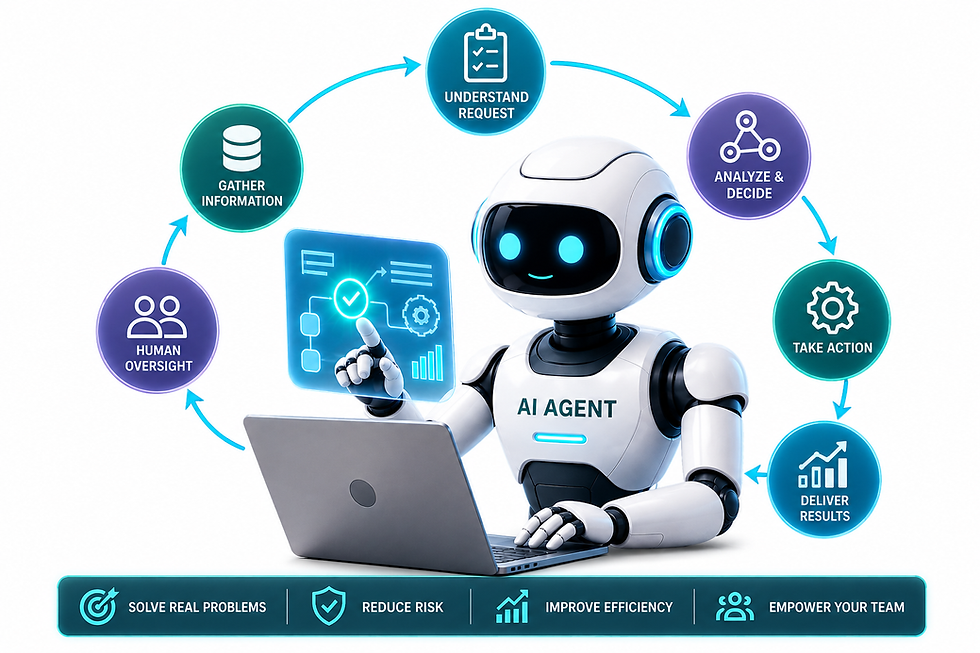
An AI agent is a software system that uses an AI model to interpret context, select among permitted actions and use connected tools or systems to pursue a defined goal with limited autonomy. In a well-designed production environment, the agent operates within explicit permissions, validates outcomes through reliable system feedback and pauses or escalates when risk, uncertainty or exceptions exceed defined thresholds.
For example, a maintenance request might arrive through a portal or email. An AI Agent could classify the request, identify the property and work order, ask for approved missing information, route a routine request to the correct workflow, update the property-management system and notify the responsible person. If the description suggests an emergency or safety issue, the workflow should immediately escalate to a human.
The value comes from reliable coordination within clearly defined boundaries.
AI Automation vs. AI Assistant vs. AI Agent
Use the least-complex technology that reliably solves the problem.
AI agents can support these outcomes when a process requires understanding information, choosing the appropriate next step or adapting to different situations. Simpler, predictable actions such as sending reminders, updating records or changing a work-order status, are usually better handled through traditional automation.
Technology | What it is | How it works | Level of autonomy | Best for | Simple example |
AI Automation | A predefined workflow that uses AI as one or more steps in the process. | Trigger → predefined steps → outcome | 🟢 Low | Repetitive, predictable processes | When a new lead fills out a form, AI classifies the lead and the system automatically adds it to the CRM and sends an email. |
AI Assistant | An AI tool that helps a person perform a task by responding to questions, generating content, or providing recommendations. | Person asks → AI responds → person decides/acts | 🟡 Medium | Tasks requiring human interaction and judgment | A business owner asks, “Summarize my sales pipeline and identify the leads I should follow up with.” |
AI Agent | An AI system that can pursue a goal, make decisions, use tools, and execute multiple steps with limited human intervention. | Goal → AI plans → takes actions → evaluates results → adjusts | 🔴 High | Complex, multi-step processes where decisions are required | An AI agent monitors new leads, researches the company, determines lead priority, drafts personalized outreach, updates the CRM, and schedules follow-up. |
How AI Agents Improve Property Management ROI
The strongest business case connects each AI-enabled workflow to a measurable operational problem and a specific KPI.
Property-Management Problem | AI Opportunity | Primary KPI |
Repetitive intake and data entry | Interpret incoming requests, capture approved information and update records. | Administrative minutes per request |
Slow maintenance routing | Classify routine requests, route them and escalate possible emergencies. | Time to assign / acknowledge |
Vendor follow-up gaps | Send approved reminders, capture status and flag overdue work. | Overdue vendor actions |
Resident/owner status questions | Provide approved updates and route exceptions to staff. | Response time / follow-up volume |
Leasing inquiries not answered quickly | Capture inquiries, qualify using approved criteria and initiate scheduling. | Inquiry response time / follow-up completion |
Growth constrained by administrative capacity | Coordinate repetitive multi-step work across approved systems. | Units or properties supported per employee |
Some of the business cases for AI automation are:
# | Business Case | How Automation Can Help |
1 | Reduce administrative work | Use AI to interpret unstructured requests and automation to complete predictable record updates, reminders, and routing. |
2 | Improve maintenance responsiveness | Faster classification and routing can reduce delays between a service request and the responsible person. |
3 | Improve tenant/resident and owner communication | Consistent, approved updates can reduce the burden of manually answering routine status questions. |
4 | Coordinate vendors | AI-enabled workflows can identify when follow-up is needed, while traditional automation sends approved reminders and records responses. |
5 | Improve leasing response | Faster responses to inquiries and scheduling coordination can help reduce opportunities that might otherwise go unanswered. |
6 | Increase portfolio capacity | When administrative effort falls, a team may be able to support more units or properties without a proportional increase in administrative work. |
7 | Reduce rework and missed handoffs | Structured workflows can make ownership, status, and next actions more visible, helping reduce missed steps and repeated work. |
Property Management AI Agent Use Cases
# | AI Use Case | AI Agent Application |
1 | Maintenance Request Intake & Triage | Classify routine requests, gather approved details, and route them to the appropriate person or vendor. Possible emergencies are escalated immediately. |
2 | Resident/Tenant Communication | Answer routine, approved questions, provide status updates, and route exceptions to the appropriate staff member. |
3 | Owner Communication | Prepare routine updates and identify items that require the property manager’s attention. |
4 | Vendor Coordination | Request status updates, organize vendor information, and flag potential delays for follow-up. |
5 | Leasing Inquiries | Capture inquiry requirements, qualify inquiries using approved criteria, and initiate scheduling workflows. |
6 | Renewal Follow-Up | Trigger reminders and follow-up tasks while leaving renewal decisions and negotiations to authorized staff. |
7 | Inspection & Document Processing | Extract approved information from documents and create follow-up tasks for staff review. |
8 | Reporting | Organize operational data and prepare draft summaries for management review. |
When Traditional Automation Is Better
Not every property-management process requires an AI Agent. If the process is predictable and the trigger and action are clear, traditional workflow automation is usually simpler and easier to govern.
Example: when a work order changes to 'completed,' automatically send an approved notification, update a task and request a review. That is a deterministic automation problem.
An AI Agent becomes more useful when the input is unstructured, context must be interpreted, or the next approved action varies within defined guardrails. Coordinating several systems does not independently justify an AI agent. Platforms such as Make, Zapier and n8n can coordinate multiple systems through predictable workflows.
It is important to remember that AI Agents can introduce additional cost, processing time, testing requirements, and the possibility of compounding errors. Their added complexity should be justified by measurable improvements that simpler technology cannot achieve
How to Measure the ROI of Property Management Automation
Property management automation should be measured by the business value it creates, not by how advanced the technology is. Before implementation, establish a baseline for the current process - for example, how much time the team spends handling maintenance requests, responding to tenant or resident questions, sending follow-ups, updating records, or preparing reports.
Then define what the automation is expected to improve, such as reducing administrative time, speeding up responses, reducing missed requests or errors, and allowing the property management team to handle more work without adding the same amount of staff time.
For example, a property management company may automate part of its maintenance request process. The system could receive a request, capture the information, route it to the appropriate person or vendor, send updates, and create follow-up tasks. The property manager and team would still handle situations that require judgment or direct communication.
A practical business case can consider employee time released, avoided rework, improved response times, and other measurable operating benefits. The following variables can be used to build a simple ROI calculation:
ROI Variable | What to Measure | Example |
Hours saved | Employee hours reduced through automation | 7 hrs/week |
Labor cost per hour | Hourly cost of the employee(s) involved | $30/hour |
Annual labor capacity released | Hours saved × 52 weeks × labor cost | $10,920 |
Error/rework savings | Costs avoided through fewer errors, corrections, duplicate work, or missed requests | $2,000/year |
Avoided costs | Other recurring costs reduced or eliminated | $1,000/year |
Annual business benefit | Labor capacity + error/rework savings + avoided costs | $13,920 |
Automation cost | Software + implementation + integration + training + support | $7,000/year |
Net annual benefit | Annual business benefit − automation cost | $6,920 |
Simple ROI Formula
ROI = (Annual Business Benefit − Automation Cost) ÷ Automation Cost × 100
For example, if property management automation creates an estimated $13,920 in annual business value and costs $7,000 per year, the potential ROI would be approximately 99%. This is an illustrative example; actual results depend on the process, implementation cost, adoption, performance, and business conditions.
The most important step is to compare the process before and after automation. Track measures such as response time, employee hours spent, number of requests handled, follow-up completion, errors, rework, and workload.
After the first 30–90 days, the property management team can review whether the automation is being used consistently and whether it is improving the targeted process. Longer-term business impact may require additional time to measure. If the automation is reliable and producing measurable value, consider expanding it to other processes. If results are limited, simplify or adjust the workflow, or determine whether a different, simpler approach would achieve the same outcome.
Property Management Example
A practical starting point could be maintenance request management. Instead of having employees manually review every request, enter information into multiple systems, determine who needs to respond, and send repeated updates, automation can handle the routine steps of the process.
The goal is not to replace the property manager's judgment. The goal is to reduce the administrative work surrounding the process, giving the team more time to focus on residents, owners, vendors, property issues, and decisions that require human attention.
Important: These scenarios are alternatives, not additive outcomes. Capacity released is not automatically payroll savings, and the same operational improvement should not be counted twice as both capacity value and incremental revenue.
What Property Managers Should NOT Let AI Decide
AI should assist with classification, routing, drafting and coordination—not independently determine whether a situation is safe, lawful, fair, financially appropriate or contractually acceptable. Emergency or safety-related requests should be escalated immediately to an authorized person. The same principle applies to eviction or legal decisions, fair-housing-sensitive decisions, financial approvals, security/access decisions, tenant or owner disputes, sensitive personal-data decisions, and vendor termination or material contractual decisions.
Control | Recommended Practice |
Least privilege | Give the Agent only the system access and actions required for its approved workflow. |
Approval thresholds | Require human approval before consequential financial, legal, contractual or customer-impacting actions. |
Escalation rules | Define when uncertainty, emergency cues or exceptions must stop the workflow and involve a person. |
Audit logs | Record material inputs, actions, approvals, exceptions and outcomes. |
Data controls | Limit sensitive data access, use approved systems and define retention/access requirements. |
Monitoring and ownership | Assign a process owner and review reliability, exceptions and business KPIs after launch. |
AI should not make or independently determine fair-housing-sensitive decisions, such as tenant screening or housing eligibility. HUD guidance on the application of the Fair Housing Act to tenant screening makes clear that the Fair Housing Act applies to housing decisions regardless of the technology used, including AI and algorithmic tools.
Property managers should not delegate high-impact decisions without appropriate human control.
Examples include emergency or safety decisions, eviction or legal decisions, fair-housing-sensitive decisions, financial approvals, security/access decisions, tenant or owner disputes, sensitive personal-data decisions and material vendor-contract decisions.
Recommended controls include least-privilege access, approval thresholds, escalation rules, audit logs, data-access controls, monitoring and clear ownership. The more autonomy an Agent receives, the stronger the governance must be.
These governance practices are consistent with the NIST AI Risk Management Framework (AI RMF), a voluntary framework for managing AI risks and incorporating trustworthiness considerations into AI systems.
1TC Perspective The goal is not to deploy more AI. The goal is to create measurable business value with the right level of automation, cost, risk, and human oversight. |
Property Management AI Readiness Checklist
# | AI Readiness Question | ✓ |
1 | Is the process documented from request to completion? | ☐ |
2 | Can successful completion be verified objectively? | ☐ |
3 | Do we know the process volume, time, and cost? | ☐ |
4 | Where do requests enter the organization? | ☐ |
5 | Which systems contain the required information? | ☐ |
6 | What data is sensitive? | ☐ |
7 | Could traditional automation solve the problem? | ☐ |
8 | What may the AI Agent do without approval? | ☐ |
9 | What requires human approval? | ☐ |
10 | What happens when the AI Agent is uncertain? | ☐ |
11 | Which KPI will prove the investment worked? | ☐ |
30-60-90 Day Implementation Roadmap
Property Management Automation in South Florida
For property-management companies serving Broward, Miami-Dade and Palm Beach County, operational complexity can increase quickly as portfolios grow across multiple properties, owners, residents, vendors and service requests. The opportunity is not simply to add AI, but to create repeatable workflows that help lean teams respond consistently while maintaining appropriate human oversight.
Explore how 1TC can help you identify the right opportunities, define a practical plan, and turn it into action. Explore our AI Readiness Assessment, AI Workflow Automation, Technology Advisory and Fractional CTO/CAIO services.
Days 0–30 — Discover: map maintenance, leasing, communication and vendor workflows; establish baseline KPIs; identify data and risk boundaries.
Days 31–60 — Simplify and Pilot: remove unnecessary steps, automate deterministic tasks, pilot one controlled AI-enabled workflow and test exceptions.
Days 61–90 — Measure and Scale: compare results with baseline, strengthen governance, train staff, document ownership and expand only when measurable value is demonstrated.
The 1mpact Technology Consulting Approach
1TC Perspective Don't Automate a Broken Property-Management Process. |
In our experience, the highest-value automation opportunities rarely begin with the question, “Which AI tool should we buy?” They begin with the workflow. Before recommending an AI Agent, 1mpact evaluates the current process, the number of handoffs, the systems involved, the data required, the exceptions that occur, and the measurable business impact. Only then should the organization determine whether the right solution is traditional automation, an AI assistant, an AI Agent, or simply a better-defined process.
The goal is not to deploy more AI. It is to create measurable business value with the right level of automation, cost, risk and human oversight.
1mpact Technology Consulting uses a process-first approach: Discover → Simplify → Automate → Add AI Where It Creates Value → Control → Measure → Scale.
For property management firms, the objective is not to add another technology layer. It is to connect business processes, people and systems so the organization can respond faster, reduce administrative friction and manage portfolio growth with greater confidence.
1TC remains vendor-neutral: the recommended solution should be based on the process, existing technology environment, data, risk, budget and measurable business objective.
Capability | Rules-Based Automation | AI Assistant / Chatbot | AI Agent |
Role | Execute predefined steps | Answer, summarize, draft | Coordinate approved multi-step actions |
Inputs | Structured data | Questions/prompts | Messages, documents, system data |
Decision logic | Fixed rules | Contextual response | Contextual interpretation within guardrails |
Property example | Status-triggered notification | Answer routine policy question | Triage, route and coordinate a request |
Human control | Exceptions | Review outputs | Approvals, escalation and monitoring |
Complexity | Low | Moderate | Higher |
1TC Perspective Don't start with the Agent. Start with the property-management process. |
Frequently Asked Questions
What is an AI Agent for property management?
An AI Agent is software that can interpret information, determine the next approved step, use connected systems, execute multiple workflow actions and escalate exceptions. In property management, it can support maintenance intake, vendor follow-up, resident communications, leasing inquiries and CRM or property-management-system updates. The Agent should operate within defined permissions and should escalate emergencies, legal issues, disputes and other high-risk situations to people.
How can AI Agents improve property management ROI?
They can reduce repetitive administration, improve response times, reduce missed follow-ups, coordinate vendors and increase the capacity of property-management teams. ROI should include direct cash savings, avoided costs, protected or incremental revenue, released capacity and measurable service improvements. The business case should use the firm's own baseline rather than assume a universal savings percentage.
Can AI automate maintenance requests?
AI can support defined parts of the process. It can interpret a written request, classify a routine issue and gather approved missing information. Traditional automation can then create or update the work order, notify the appropriate person and send status updates. Possible emergencies, safety risks and unusual situations should be escalated immediately through an approved human-led process.
Can AI help property managers respond to tenants faster?
Yes. AI-enabled workflows can acknowledge requests, answer approved routine questions, collect information, provide status updates and route exceptions. Faster response can improve service quality and reduce repetitive phone and email handling. Property managers should establish approved response content, escalation rules and data-access controls so that the system does not make unauthorized commitments.
Can AI Agents coordinate vendors?
They can coordinate routine administrative steps such as requesting status updates, recording responses, sending approved reminders and flagging overdue work. The property manager should retain control over vendor selection, contractual decisions, material scope changes, disputes and other high-impact actions. The objective is to reduce coordination friction rather than remove professional oversight.
Can AI help with leasing inquiries?
AI can capture inquiries, answer approved questions, collect basic requirements, route qualified prospects and initiate scheduling workflows. This can improve response speed and reduce administrative workload. Decisions involving protected characteristics, fair-housing-sensitive criteria, pricing exceptions or other regulated or high-impact matters should remain under appropriate human control.
How much can property managers save with AI automation?
There is no reliable universal savings figure. Savings depend on portfolio size, request volume, labor cost, process design, technology cost and adoption. A property manager should measure current administrative hours, response times, rework, vendor delays and missed opportunities first. Then calculate direct savings separately from released staff capacity and service or revenue benefits.
Explore Your Property Management Automation Opportunities!
Is your property-management team spending too much time coordinating repetitive work? 1mpact Technology Consulting can help you identify the highest-value automation opportunities, evaluate where AI Agents make sense, and build a practical roadmap based on measurable business outcomes. Schedule a free Property Management Technology Consultation! Click here. |
Author & Expertise
Written by Rose Fasanelli, Partner & Business Development Director.
Rose Fasanelli brings more than 35 years of global technology leadership experience across digital transformation, business growth, customer experience, AI, automation and technology-enabled innovation. She has been recognized as a HITEC 100 honoree and brings enterprise-level technology experience to the SMB market. Connect via LinkedIn
Reviewed by Vanessa Ballarte, Partner & AI Solutions Director.
Vanessa is a business and technology executive with more than 25 years of experience across corporate strategy, P&L management, operations, AI & digital transformation. A former Managing Director and Board Member of OMRON Healthcare, Vanessa now serves as Director of AI Solutions at 1TC, where she helps organizations turn strategic priorities and emerging technologies into practical solutions that deliver measurable business impact. Connect via LinkedIn
References
Source | Link | Brief description of content / recommended use |
NIST — AI Risk Management Framework (AI RMF) | Official NIST framework for managing AI risks and incorporating trustworthiness into the design, development, deployment, use, and evaluation of AI systems. Excellent authoritative reference when discussing AI governance, risk management, responsible AI, and AI-enabled workflows. (NIST) | |
NIST — AI RMF 1.0 Publication | The formal NIST publication describing the AI RMF 1.0. It is voluntary, sector-agnostic, and designed to help organizations manage AI risks while promoting trustworthy and responsible AI. Good citation when making a specific statement about the framework. (NIST) | |
NIST — AI RMF Playbook | Practical companion to the AI RMF, organized around Govern, Map, Measure, and Manage. Particularly useful if your blog discusses how SMBs can translate AI governance principles into practical workflows and controls. (NIST) | |
HUD — Housing Discrimination Under the Fair Housing Act | Official HUD overview of the Fair Housing Act, including protected characteristics and housing-related activities covered by the law. Strong general-purpose source for discussions of AI and fairness in housing decisions. (HUD) | |
HUD — Fair Housing Rights and Obligations | Explains fair housing rights, obligations, enforcement, and discrimination protections. Useful when discussing tenant screening, housing decisions, advertising, lending, and technology-enabled decision-making. (HUD) | |
HUD — AI & Tenant Screening Guidance | Highly relevant to your topic. Specifically addresses the use of machine learning and AI in tenant screening and explains that the Fair Housing Act applies regardless of the technology used. This is probably the strongest HUD link for a blog discussing AI in property management. (HUD Archives) | |
HUD — AI & Digital Housing Advertising Guidance | Addresses application of the Fair Housing Act to digital advertising, including algorithmic targeting and AI-enabled advertising for housing and real-estate-related transactions. Very useful if your blog discusses AI marketing or automated advertising for property management. (HUD) | |
1mpact Technology Consulting — AI Automation Services | Explains 1mpact's approach to AI automation for South Florida SMBs, including workflow automation, CRM integration, scheduling, reporting, customer follow-up, and administrative processes. Strong link for the practical technology and measurable business value positioning in your blog. (1mpact Technology Consulting (1TC)) | |
1mpact Technology Consulting — Technology Advisory | Describes 1mpact's broader technology advisory approach, including technology strategy, AI adoption, SaaS implementation, workflow automation, and technology stack optimization for SMBs in Miami-Dade, Broward, and Palm Beach. (1mpact Technology Consulting (1TC)) | |
1mpact Technology Consulting — South Florida Business Process Automation | Particularly good for the requested South Florida SMB technology and automation research reference. Discusses business process automation, productivity, operational efficiency, and practical applications for South Florida SMBs. (1mpact Technology Consulting (1TC)) | |
1mpact Technology Consulting — AI Readiness Assessment | Provides a practical framework for assessing where AI and automation can create value for SMBs, including reviewing current operations, data, tools, and potential opportunities before investing in technology. (1mpact Technology Consulting (1TC)) | |
1mpact Technology Consulting - Blog - AI Agents for Small Business | This blog provides comprehensive and concise insights on AI Agents for Small Business |


Comments