
South Florida Business Process Automation: 15 Ways Small Business Can Save Time and Reduce Costs
Updated: Aug 25
Context & Quick answer Business process automation helps small and mid-sized businesses use software, connected systems, and workflow rules to complete repetitive tasks with less manual work. The best opportunities are often frequent, repeatable processes such as lead follow-up, scheduling, customer requests, reporting, invoicing, and data entry. Today, advances in technology have expanded what businesses can automate, with artificial intelligence (AI) providing new opportunities to interpret information, support decisions, and handle processes that go beyond traditional rules-based automation. Key Operational Principles: A
|

Business Process Automation: Why It Matters for South Florida SMBs
For a small or mid-sized business, time is one of the few resources you cannot buy back. Every hour an owner, office manager, estimator, property manager, salesperson, or coordinator spends copying information between systems, chasing a response, preparing a repetitive report, or routing a request is an hour that could have been used to serve customers, sell, manage projects, or grow the business.
Business process automation can reduce that operational friction by moving repetitive, predictable work from people to connected software workflows. When artificial intelligence (AI) is added selectively, automation can also interpret emails, extract information from documents, classify requests, summarize conversations, and prepare next actions.
The objective is not to automate people. It is to automate the repetitive work around the work so your team can spend more time on the decisions, relationships, and expertise that create value.
Business Process Automation
→ traditional workflow automation
→ integrations
→ rules and triggers
→ data synchronization
→ reporting automation
→ task automation
→ AI as an optional capability when required
Automation is the main subject. AI is one tool that can be added when the process requires it.
The opportunity is increasingly relevant. Recent advances in technology have expanded the range of business processes that can be automated, including workflows that previously required people to interpret documents, messages, and other unstructured information. The recent US Census data show that AI usage hovered between 17% and 20%, and between 20% and 23% of businesses are expected to be using it in the next six months. More details can be found in the US Census study.
The 1mpact Technology Consulting (1TC) Strategy: Automate the Work Around the Work
The strongest automation opportunities are usually not the core expertise that differentiates the business. They are the administrative steps surrounding that expertise.
Contractors: automate lead capture, estimate follow-up, scheduling, job updates, and document intake, not the professional judgment behind the estimate or the work performed on site.
Property managers and HOAs: automate maintenance-request intake, routing, vendor communication, status updates, and recurring reporting, not the manager's judgment on sensitive or urgent issues.
Realtors & Property Mgmt.: automate lead acknowledgment, appointment coordination, document collection, reminders, and CRM updates, not negotiations or relationship management.
Nonprofits: automate participant intake, volunteer coordination, communications, document processing, and recurring reporting, not mission-critical decisions or sensitive human interactions.
This approach also keeps technology practical. Traditional workflow automation is usually best for predictable rules. AI is valuable when the process requires interpretation, extraction, classification, summarization, or contextual generation. The right question is not “Where can we add AI?” It is “Which repetitive work is consuming valuable employee time, and what is the simplest technology that can handle it safely?”
1TC Practical Rule: Before asking 'Where can we use AI?' ask: 'What repetitive administrative work is taking our team's time that technology could handle more efficiently?' Then choose the simplest approach that solves the problem reliably. |
15 Business Processes South Florida SMBs Can Automate
The 15 opportunities below combine the strongest automation use cases from the 1mpact Technology Consulting framework with additional operational processes that commonly create administrative friction. Each one is designed around the same principle: save employee time first, then measure the downstream effect on cost, speed, capacity, customer experience, or revenue.
1. Lead Capture, Acknowledgment & Follow-Up
Automate the path from a website form, email, phone inquiry, or social lead into the CRM. Create the CRM record automatically; identify the service requested; assign ownership; send an immediate acknowledgment; schedule follow-up tasks; and flag incomplete information.
AI can interpret free-form inquiries, classify the service need, summarize the request, and draft a context-aware response for review.
Best fit: Contractors, HVAC, remodeling, landscaping, real estate, professional services.
Time value: Eliminates repeated data entry and manual lead triage while reducing the chance that a new inquiry sits unanswered.
Human role: Salespeople retain responsibility for qualification, pricing, estimates, objections, and relationships.
2. Appointment Scheduling & Reminders
Automate confirmations, reminders, intake forms, cancellations, rescheduling notices, and post-appointment follow-up. Use rules-based workflows for standard reminders and notifications. Add AI only when customers communicate scheduling changes in natural language or ask questions that require interpretation.
For spas, wellness businesses, clinics, home services, and real estate teams, this can reduce the administrative back-and-forth surrounding every appointment.
Best fit: Wellness & spas, clinics, home services, realtors, consultants.
Time value: Reduces repetitive phone calls, texts, emails, calendar updates, and manual reminder work.
Human role: Staff handle exceptions, special requests, sensitive questions, and complex scheduling conflicts.
3. Customer Inquiry & Request Routing
Automatically classify incoming requests and route them to the right employee, property, department, vendor, or workflow. AI can identify whether a message concerns billing, maintenance, access, landscaping, HVAC, scheduling, or another category; extract location or customer details; assess defined urgency criteria; and produce a short summary.
Workflow rules then send the request to the correct destination.
Best fit: Property management, HOAs, home services, nonprofits, customer-service teams.
Time value: Replaces manual inbox sorting and reduces the number of requests that remain in the wrong queue.
Human role: Employees review urgent, unclear, sensitive, or unusual requests.
4. Estimate, Proposal & Quote Follow-Up
Trigger follow-up tasks automatically when an estimate or proposal is sent and no response is received. Set defined follow-up intervals; create salesperson tasks; notify owners of aging opportunities; and use AI to draft personalized follow-ups based on the original inquiry and conversation history.
This turns follow-up from a memory-dependent activity into a repeatable workflow.
Best fit: Contractors, remodeling, HVAC, landscaping, professional services.
Time value: Removes the need for staff to maintain manual follow-up lists and repeatedly search for stale estimates.
Human role: Salespeople manage negotiations, pricing, objections, and relationship recovery.
5. Maintenance & Service Request Management
Automate intake, classification, assignment, status updates, and escalation for maintenance and service requests. A tenant or customer can submit a message; AI can extract the property, equipment, problem description, and requested service; workflow rules can assign the ticket; and automated updates can keep the requester informed.
This is particularly useful when several properties, technicians, or vendors are involved.
Best fit: Property management, HOAs, HVAC, plumbing, electrical, landscaping.
Time value: Reduces repeated triage, phone calls, status checks, and manual handoffs.
Human role: Qualified staff or vendors diagnose the actual problem and determine corrective action.
6. Recurring Reports & Dashboards for Business
Automate the collection, calculation, and presentation of recurring operational information. Connect CRM, accounting, project-management, property-management, or other systems to a business intelligence dashboard; calculate standard KPIs; distribute reports automatically; and use AI to summarize meaningful changes.
This is also a strong use case for automating financial reporting when the data sources and definitions are reliable.
Best fit: Owners, property managers, nonprofits, multi-location businesses, professional services.
Time value: Reduces spreadsheet consolidation and repetitive weekly or monthly reporting.
Human role: Management investigates exceptions and makes decisions based on the information.
7. Invoice, Collections & Payment Follow-Up
Automate invoice reminders, due-date alerts, payment-status checks, and staff tasks for exceptions. Standard reminders should normally be rules-based. AI can add value when a customer replies with an explanation, dispute, or unusual request by summarizing the exchange and routing it for personal attention.
The workflow can also synchronize payment status with the CRM or accounting system.
Best fit: Contractors, property managers, professional services, nonprofits.
Time value: Removes repetitive collection administration and reduces manual status checking.
Human role: Staff handle disputes, payment arrangements, sensitive accounts, and exceptions.
8. Document Intake, Data Extraction & Classification
Use AI to read incoming documents and extract structured information before routing them into a workflow. AI can identify document type, extract fields, check whether required information is present, classify the document, and route it to the correct folder, record, approval process, or employee.
Examples include vendor invoices, applications, contracts, receipts, insurance certificates, property documents, and participant forms.
Best fit: Property management, nonprofits, contractors, professional services.
Time value: Reduces opening, reading, copying, naming, filing, and re-entering information from documents.
Human role: Important financial, contractual, compliance, or consequential information should be validated before action.
9. Customer Feedback & Review Management
Automatically request feedback after a completed service, appointment, transaction, or project and analyze responses. Workflow automation handles the request. AI can analyze sentiment, identify recurring complaints, summarize themes, and flag comments that require immediate human attention.
This creates a repeatable feedback loop rather than relying on employees to remember to ask customers.
Best fit: Home services, wellness, real estate, professional services.
Time value: Removes manual feedback administration and accelerates identification of issues.
Human role: Employees handle complaints, service recovery, and sensitive conversations.
10. New Employee & Contractor Onboarding
Automate the administrative sequence that begins after a new person is approved to join the business. Trigger onboarding checklists; send required forms; create accounts and tasks; schedule orientation; notify managers; and track completion. Rules-based validation can identify missing fields and AI can summarize submitted information.
For contractors and field teams, the same workflow can include certificates, access, safety acknowledgments, and required documentation.
Best fit: Growing contractors, property managers, service businesses, nonprofits.
Time value: Reduces repeated emails, checklist chasing, and manual coordination between HR, operations, IT, and managers.
Human role: Managers approve access, compensation, role assignments, and exceptions.
11. Vendor Onboarding & Coordination
Automate vendor intake, document collection, approvals, assignments, and recurring reminders. Create a vendor record; request W-9s, insurance documents, licenses, contracts, or other required information; track expiration dates; route approvals; and notify the responsible employee when something is missing or expiring.
AI can classify documents and extract dates or vendor details before the workflow updates the record.
Best fit: Property management, construction, nonprofits, facilities and home services.
Time value: Reduces manual chasing and duplicate data entry across vendor files and systems.
Human role: Procurement, legal, finance, or management retains approval authority.
12. Financial Data Entry & Reporting Preparation
Automate the movement of financial information between approved systems and the preparation of recurring management reports. Use integrations to reduce duplicate entry between accounting, CRM, project-management, and reporting tools. Automate standard calculations and recurring report preparation; use AI to summarize trends only after the underlying data is validated.
The goal is not to automate accounting judgment. It is to remove repetitive preparation work.
Best fit: Service businesses, contractors, property managers, nonprofits.
Time value: Reduces spreadsheet manipulation, data copying, reconciliation preparation, and recurring reporting effort.
Human role: Finance professionals and owners remain accountable for financial controls, approvals, reconciliations, and reporting decisions.
13. Marketing Content & Campaign Operations
Automate repeatable marketing administration without automating the brand's strategic judgment. Repurpose approved content into email drafts, social posts, FAQs, or campaign variations; schedule approved communications; capture responses in the CRM; and create follow-up tasks.
AI is useful for drafting and summarization, while workflow automation handles timing, routing, and record updates.
Best fit: Realtors, home services, wellness businesses, nonprofits, professional services.
Time value: Reduces repetitive content formatting, campaign setup, list management, and follow-up administration.
Human role: Marketing or leadership approves claims, offers, brand voice, and final publication.
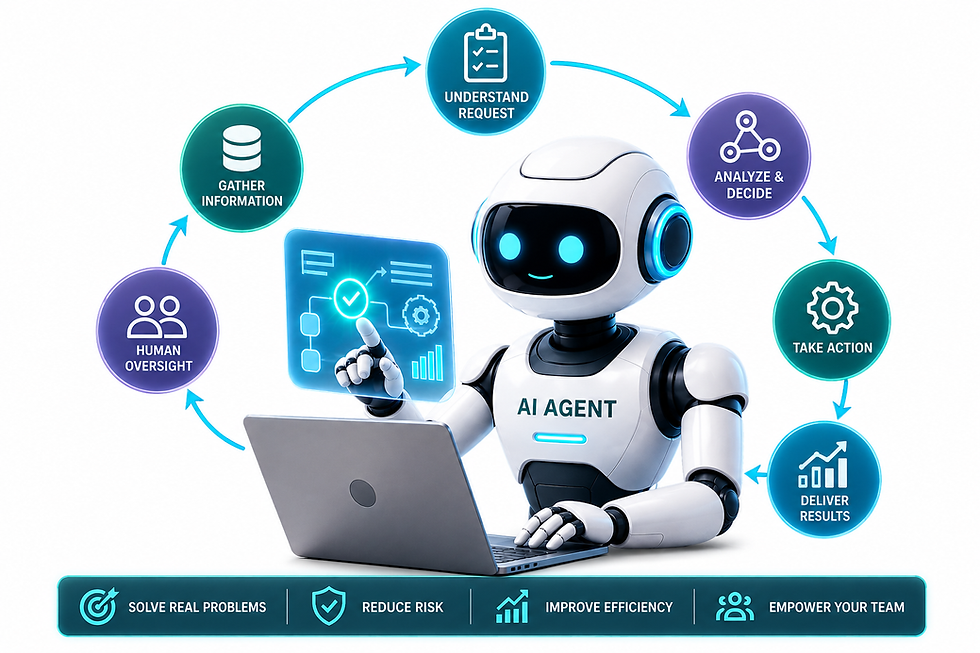
14. Multi-Step Coordination with AI Agents
For carefully selected workflows, an AI agent handles a series of connected tasks for a specific business process. An onboarding agent, for example, could review a CRM record, identify missing intake information, request it, create internal tasks, prepare a checklist, and escalate items that require approval.
Agents should operate inside defined permissions, with limited access and human approval for highly sensitive actions.
Best fit: Businesses with mature systems, stable processes, clear permissions, and meaningful coordination overhead.
Time value: Reduces administrative handoffs across multiple systems and people.
Human role: People remain accountable for approvals, sensitive decisions, exceptions, and the boundaries within which the agent operates.
15. Data Synchronization & Business Intelligence Dashboards
Connect the systems employees already use so the same information does not have to be entered repeatedly. Synchronize approved fields between CRM, scheduling, invoicing, accounting, project-management, forms, and reporting systems. Define which system is the system of record—the main source of truth, for important information such as customer, financial, or project data. Then surface the resulting information through dashboards for business owners and managers.
A connected data flow, with clear systems of record, is often the foundation that makes later AI automation more reliable.
Best fit: SMBs using several SaaS applications that do not communicate automatically.
Time value: Eliminates duplicate entry, manual exports, spreadsheet consolidation, and repeated requests for status information.
Human role: Owners define KPI definitions, permissions, governance, and decision thresholds.
How Much Time Can Automation Save?
Do not measure automation only by headcount reduction. For an SMB, the more useful first metric is recovered employee capacity: hours that become available for customers, sales, project execution, management, or other higher-value work.
A simple baseline formula is: Hours saved per week × 52 × relevant hourly labor cost. For example, releasing six hours per week at a $30 hourly labor cost represents 312 hours of annual capacity, or $9,360 of labor capacity. That does not automatically mean payroll falls by $9,360; it means the business has more capacity without adding the same amount of administrative work. This is an estimate of annual labor capacity value, not ROI. Formal ROI should compare quantified benefits with implementation, software, integration, training, and ongoing operating costs.
To estimate the time saved through automation, 1TC recommends comparing the time required to complete a task manually with the human time still required after automation, then multiplying the difference by the expected annual volume of transactions. This approach is similar to automation ROI methods that consider baseline processing time, transaction volume, rework, and human review effort, including UiPath’s Automation Hub framework, when estimating annual hours saved.
Where South Florida SMBs Can Start
Business Type | High-Value Automation Opportunities | Primary Time-Saving Outcome |
General Contractors & Home Services | Lead response, estimate follow-up, scheduling, service requests, documents | Less office administration and faster customer response |
Realtors | Lead routing, appointment coordination, CRM updates, document intake | Less follow-up administration and fewer missed handoffs |
Property Managers & HOAs | Maintenance intake, vendor coordination, document processing, reporting | Less triage, fewer status calls, better visibility |
Nonprofits | Participant intake, volunteer workflows, communications, documents, reporting | More staff capacity for mission-focused work |
Wellness & Spas | Scheduling, reminders, lead follow-up, feedback | Less front-desk administration and fewer no-shows |
SMB Automation Readiness Checklist
Use these questions before buying another automation tool. The direct answer to each question should be visible in your process map, not assumed.
Does this process happen frequently?
Yes is a strong signal. A process that occurs dozens or hundreds of times per month can create meaningful time savings even when each individual task takes only a few minutes.
Is the process reasonably repeatable?
If the same basic steps happen each time, automation is usually feasible. If every case is completely different, begin with intake, classification, or administrative steps rather than trying to automate the entire process.
Can we measure the current time spent?
Measure the baseline first. Track minutes per transaction, transactions per week, error/rework rate, response time, or backlog before changing the process.
Do our systems share reliable data?
Automation works best when CRM, accounting, scheduling, forms, and other systems have consistent fields, ownership, permissions, and integration options.
Does this actually require AI?
No. Use traditional workflow automation for predictable rules. Use AI when interpretation, extraction, classification, summarization, or contextual generation is genuinely required.
What happens if the automation is wrong?
Define the consequence before deployment. Low-risk errors may need alerts and correction. Financial, contractual, compliance, privacy, or customer-impacting actions may require human approval.
Who owns the process after launch?
Assign a business owner who can monitor results, approve changes, and make sure the workflow continues to match how the company operates.
A Practical 5-Step Automation Roadmap
Map the current process: Document what actually happens today, including emails, spreadsheets, handoffs, approvals, exceptions, and duplicate data entry.
Baseline the effort: Measure time, volume, delays, error rates, response times, and other business metrics before automation.
Choose the simplest technology: Start with rules-based workflow automation. Add AI only where interpretation or unstructured information makes it valuable.
Pilot one high-value workflow: Choose a process that is frequent, measurable, relatively low-risk, and owned by a team member who will use it.
Measure, train, adopt, and optimize: Compare results against the baseline, train users, monitor exceptions, drive adoption, and improve the workflow before expanding it.
Why Business Process Automation Is Becoming a Competitive Advantage
Small businesses do not need enterprise-sized technology budgets to benefit from automation. They need focused use cases, clean enough data, connected systems, clear ownership, and an implementation approach that respects the way the team actually works.
NFIB's 2025 technology survey found that 30% of small employers using AI reported increased productivity, 23% reported improved product or service quality, 8% reported lower operating costs, 5% reported increased revenue, and 4% reported increased sales. These figures are self-reported outcomes across a broad small-business population, so they should not be interpreted as a guaranteed ROI benchmark for an individual company.
For South Florida SMBs competing on speed, responsiveness, service quality, and limited administrative capacity, the practical question is no longer whether automation exists. It is which process should be improved first.
How 1mpact Technology Consulting Can Help
1mpact Technology Consulting (1TC) helps South Florida SMB owners move from scattered technology tools and manual processes to practical, measurable automation. The company starts with the business process, not a software product, and evaluates where workflow automation, AI automation, integrations, dashboards, or fractional technology leadership can create the most value.
1TC's AI automation services include workflow assessment, opportunity prioritization, tool and integration recommendations, implementation, team training, and post-launch optimization, user training multilingual, and adoption support. Its approach is designed for businesses that may not have a dedicated IT organization but still need senior technology guidance.
Workflow discovery and process mapping to identify bottlenecks and manual work.
Business process automation solutions that connect CRM, scheduling, invoicing, communication, and other SaaS systems.
AI automation services for document intake, classification, summarization, customer inquiries, reporting, and other unstructured workflows.
Business intelligence dashboards and reporting automation so owners can spend less time assembling information and more time acting on it.
AI readiness and technology assessments that prioritize opportunities by business value, feasibility, and risk.
Fractional CTO and Fractional CAIO leadership for SMBs that need ongoing senior technology and AI guidance without a full-time executive hire.
Learn more by checking the links below:
Key Takeaways for SMB Owners
Business process automation is primarily about recovering employee capacity, not replacing employees.
Start with repetitive, high-frequency processes where time savings can be measured.
Use traditional automation for predictable rules and AI for interpretation, extraction, classification, summarization, and contextual tasks.
The best automation often surrounds the core work: lead intake, follow-up, scheduling, reporting, documents, payments, and coordination.
Do not automate accountability. Keep human approval for financial, contractual, compliance, sensitive, and high-impact decisions.
For cross-system and AI-enabled automation, connected systems and reliable data are prerequisites for dependable automation.
Measure the baseline before implementation so you can prove whether the workflow actually saved time.
A focused pilot is usually better than attempting to automate the entire business at once.
For South Florida SMBs without internal technology leadership, an experienced technology advisor can reduce tool sprawl, implementation risk, and wasted effort.
The first automation should solve a real business bottleneck, not simply showcase the newest AI capability.
Top Questions SMB Owners Ask About Business Process Automation
1. What is business process automation for a small business?
Business process automation uses software and connected workflows to complete repetitive business tasks with less manual intervention. For SMBs, it can automate lead capture, scheduling, follow-up, reporting, document processing, payments, and data synchronization while keeping people responsible for decisions and exceptions.
2. How can automation save employee time?
Automation saves employee time by removing repetitive data entry, copying information between systems, manual reminders, inbox sorting, report preparation, and routine follow-up. The most useful measure is recovered capacity: hours that employees can redirect toward customers, sales, project execution, management, or other higher-value work.
3. Does business process automation require AI?
No. Traditional workflow automation is often the better choice for predictable rules such as reminders, assignments, notifications, and scheduled follow-ups. AI becomes useful when the workflow must interpret language, extract information from documents, classify requests, summarize content, or generate a contextual response.
4. What should an SMB automate first?
Start with a process that occurs frequently, consumes meaningful employee time, affects customers or revenue, follows a reasonably repeatable workflow, and can be measured. Lead follow-up, scheduling, service requests, recurring reports, document intake, and data synchronization are often strong starting points.
5. How much does business process automation cost?
The cost depends on the workflow, systems involved, integrations, data quality, security requirements, and level of customization. A focused pilot is usually more practical than a large transformation project. The business case should compare implementation and operating costs with recovered capacity, error reduction, service improvements, or revenue impact.
6. Can a contractor or home-service company automate office work?
Yes. Contractors and home-service businesses can automate lead acknowledgment, CRM entry, estimate follow-up, scheduling, service-request routing, customer updates, document intake, invoicing reminders, and reporting. These workflows reduce administrative load while keeping estimating, pricing, technical judgment, and customer relationships with people.
7. Can property managers automate maintenance requests?
Yes. A property manager can automate request intake, classification, property identification, assignment, vendor routing, status updates, and escalation. AI can interpret unstructured tenant messages and extract relevant information, while human staff remain responsible for urgent, sensitive, unusual, or consequential decisions.
8. Is automation safe for financial or customer information?
Automation can be appropriate for sensitive information when access controls, approved systems, data governance, security practices, auditability, and human-review rules are designed into the workflow. High-impact actions should not be delegated blindly to AI; the required control level depends on the information and business risk.
9. Do I need an internal IT team to automate my business?
No. An external technology advisor can assess workflows, evaluate software, design integrations, implement automation, establish controls, and support adoption. For SMBs without dedicated IT leadership, fractional CTO or fractional CAIO services can provide senior guidance without the cost of a full-time executive.
10. How do I know whether automation is delivering ROI?
Measure the baseline before implementation and compare it with post-launch results. Track hours per transaction, weekly volume, response time, errors, rework, backlog, customer experience, and capacity. Then compare quantified benefits with software, implementation, integration, training, governance, and ongoing operating costs.
Authors & Expertise
Written by Rose Fasanelli, Partner & Business Development Director.
Rose Fasanelli is a technology executive and entrepreneur with 30+ years of global leadership experience driving digital transformation, business growth, customer experience, AI, automation, data-driven insights, and technology-enabled innovation. A 2025 HITEC 100 honoree, HITEC Fellow and Mentor, Rose brings enterprise-level experience to the SMB market, helping business leaders turn technology into practical, measurable solutions that improve efficiency, strengthen customer experiences, and accelerate sustainable growth.
LinkedIn: Rose Fasanelli
Co-authored by Vanessa Ballarte, Partner & AI Solutions Director.
Vanessa is a business and technology leader with 20+ years of experience in strategy, operations, digital transformation, and AI/ML. She has led innovation initiatives and built new business capabilities, helping organizations turn technology and data into measurable improvements in efficiency, profitability, and business performance. At 1mpact, she brings this expertise to SMBs, making AI and automation practical, scalable, and results driven.
LinkedIn: Vanessa Ballarte
Take Action Now – Book a Free Discovery Call
Start with a practical automation and process assessment. If your team is spending too much time on repetitive administrative work, 1mpact Technology Consulting (1TC) can help identify the highest-value automation opportunity, determine whether traditional automation or AI is appropriate, and create a practical path to implementation. Learn more at www.1mpact-tc.com Ready to Streamline Your Operations? Start with a practical AI and process assessment - Book a Free Discovery Call |
Trusted External Sources
U.S. Census Bureau - AI adoption among U.S. businesses
UiPath ROI methodology - UiPath’s Automation Hub framework


Comments